

Deep in Yanomami territory, Brazil’s highest mountain is much more than a summit. Trekking Yaripo is a demanding journey through rainforest, culture and one of the most remote landscapes in the Brazilian Amazon.
My love story with the Amazon began in 1998.
I had been given the opportunity to accompany a photographer on an expedition to the Xixuau-Xiparina region in search of a harpy eagle nesting deep in the rainforest.
Getting there already felt like an expedition.
We traveled for days by river. Then came long walks through the forest, humidity, mud, nights sleeping in hammocks and the uncertainty that accompanies any real encounter with nature.
Eventually, we found the harpy eagle.
But what stayed with me was much bigger than that sighting.
I discovered how much I loved moving through the rainforest on foot.
There was something about the physical effort, the simplicity of expedition life and the feeling of reaching places that cannot be experienced without committing yourself to the journey.
Years later, trekking would take me to many extraordinary places.
But Pico da Neblina — Yaripo — would become one of the most meaningful.
And anyone considering this expedition should understand from the beginning:
This is not simply a trek to Brazil’s highest mountain.
It is a journey into Yanomami territory, through one of the most remote regions of the Brazilian Amazon, to a mountain that has profound cultural and spiritual meaning for the people who have lived there for generations.

Quick Answer: What Should You Expect From the Pico da Neblina Trek?
The Pico da Neblina trek, known to the Yanomami as Yaripo, is a demanding rainforest expedition to Brazil’s highest mountain, reaching approximately 2,995 meters above sea level.
Expect:
- several days of trekking through dense tropical rainforest;
- heat, humidity, mud and rain;
- steep and technically demanding terrain in some sections;
- simple expedition camps;
- changing temperatures as altitude increases;
- limited infrastructure and no conventional comforts;
- a journey operated according to strict visitation rules;
- and, above all, an experience taking place within Yanomami territory and guided by Yanomami protocols and leadership.
This is not a conventional hiking holiday.
It requires physical preparation, flexibility and respect for the territory you are entering.
Pico da Neblina or Yaripo?
Most Brazilians know the mountain as Pico da Neblina, the highest mountain in Brazil.
For the Yanomami, however, it is Yaripo, a sacred mountain within their territory.
That difference in names tells us something important about the journey.
A visitor may arrive thinking primarily about reaching Brazil’s highest summit.
The people who live there understand the mountain through a completely different relationship with territory, ancestry, spirituality and the forest.
Yaripo is not simply a geographic landmark.
It belongs to a cultural landscape.
And I believe understanding that before beginning the trek fundamentally changes the experience.
The current Yaripo visitation initiative is led by Yanomami organizations and supported by a formal visitation plan involving Funai and ICMBio. In 2026, Funai renewed its institutional approval of the plan, emphasizing community autonomy, territorial protection, cultural appreciation and conservation.
Where Is Pico da Neblina?
Pico da Neblina lies in the far northwestern Brazilian Amazon, close to the border with Venezuela, within the municipality of São Gabriel da Cachoeira, Amazonas.
At approximately 2,995 meters above sea level, it is the highest mountain in Brazil.
But looking at its altitude alone tells you very little about the difficulty of reaching it.
The expedition begins almost at Amazonian lowland level.
The official visitation information describes the journey beginning in the Maturacá region at approximately 95 meters above sea level before progressing through rainforest toward the summit.
That means the journey is not simply about altitude.
It is about distance, terrain, tropical conditions and remoteness.
Getting There Is Part of the Expedition
One of the things that makes Yaripo so different from many famous trekking destinations is that you don’t simply arrive at a trailhead and begin walking.
First you need to reach São Gabriel da Cachoeira, one of the most remote towns in Brazil.
From there, the journey continues toward the Yanomami territory and Maturacá region before the trekking portion begins.
Road and river travel are part of the expedition.
The transition is gradual.
Urban Brazil disappears.
The Rio Negro and its tributaries take over.
The forest becomes increasingly dominant.
And by the time you finally begin walking, you already understand that remoteness is not an attraction added to this expedition. It defines it.
How Difficult Is the Pico da Neblina Trek?
This is probably the most important practical question.
My answer is simple:
It is demanding.
You do not need to be a technical mountaineer, but this is not an appropriate place to discover whether you enjoy hiking.
The challenge comes from a combination of factors.
Long Days on Foot
Expect several hours of trekking on many days, carrying your personal equipment through rainforest terrain.
Heat and Humidity
At lower elevations, the Amazon can be intensely warm and humid.
Even experienced hikers accustomed to mountains in cooler climates can underestimate how physically demanding tropical conditions are.
Mud
Rainforest trails can be muddy.
Very muddy.
Sometimes accepting that your boots and clothes will not remain clean is one of the first psychological adjustments of the expedition.
Steep Terrain
As elevation increases, parts of the route become considerably steeper and more demanding.
Rain
Rain is not an exceptional event here.
It is part of the environment.
Remoteness
Perhaps most importantly, you are far from conventional infrastructure.
There is no comfortable lodge waiting at the end of each hiking day.
This changes the way you need to approach the expedition mentally as well as physically.


Do You Need Previous Trekking Experience?
I strongly recommend it.
You should be comfortable walking for several consecutive days and understand how your body responds to long physical efforts.
Previous experience with:
- multi-day trekking;
- uneven terrain;
- carrying a daypack;
- tropical or humid environments;
- basic camps;
- and physically demanding outdoor travel
will make a significant difference.
You do not need to arrive as an elite athlete.
But you should arrive prepared.
Physical conditioning should begin well before departure, with particular attention to cardiovascular endurance, leg strength, balance and walking on uneven terrain.
What Are the Camps Like?
Simple.
And I think travelers need to understand that before booking.
Yaripo is not a trekking route where luxury camps suddenly appear in the middle of the forest.
Expedition infrastructure is intentionally basic.
Sleeping arrangements, meals and daily routines are designed around the reality of traveling through an extremely remote rainforest environment.
Comfort becomes relative.
After hours of walking, dry clothes feel luxurious.
A warm meal feels luxurious.
Taking off your boots feels luxurious.
Sitting quietly with the team at the end of the day can become one of the best moments of the expedition.
That simplicity is part of the experience.
What Is the Weather Like?
Expect change.
At the beginning of the expedition, conditions can be typically Amazonian: hot, humid and wet.
As you gain elevation, temperatures fall.
Rain, clouds, mist and wind can occur, particularly higher on the mountain.
This is one of the reasons flexibility is essential.
No responsible expedition should treat reaching the summit as something guaranteed.
Weather decides.
So does safety.
And sometimes respecting the mountain means accepting that the plan needs to change.
Is Reaching the Summit Guaranteed?
No.
And I would be cautious of anyone presenting it that way.
Weather, trail conditions, physical condition and safety considerations can all affect whether the summit is reached.
For many trekkers, standing on Brazil’s highest point is understandably a powerful objective.
But Yaripo is one of those journeys where concentrating only on the summit can make you miss most of what is happening around you.
The forest changes as you climb.
Vegetation changes.
Temperature changes.
Your relationship with the people walking beside you changes.
Your perception of distance changes.
And eventually your own rhythm changes.
The summit is part of the expedition. It is not the whole expedition.
The Yanomami Are Not Part of the Attraction. They Lead the Experience.
This distinction matters enormously to me.
Tourism at Yaripo exists today under a model designed around Yanomami participation and governance.
The current visitation plan is led by the Associação Yanomami do Rio Cauaburis e Afluentes (AYRCA) and Associação das Mulheres Yanomami Kumirayoma (AMYK). Funai describes the initiative as community-based ecotourism connecting income generation, cultural appreciation, territorial protection and environmental conservation.
Yanomami people participate throughout the operation.
But travelers should not think of them merely as porters, cooks or guides facilitating someone else’s expedition.
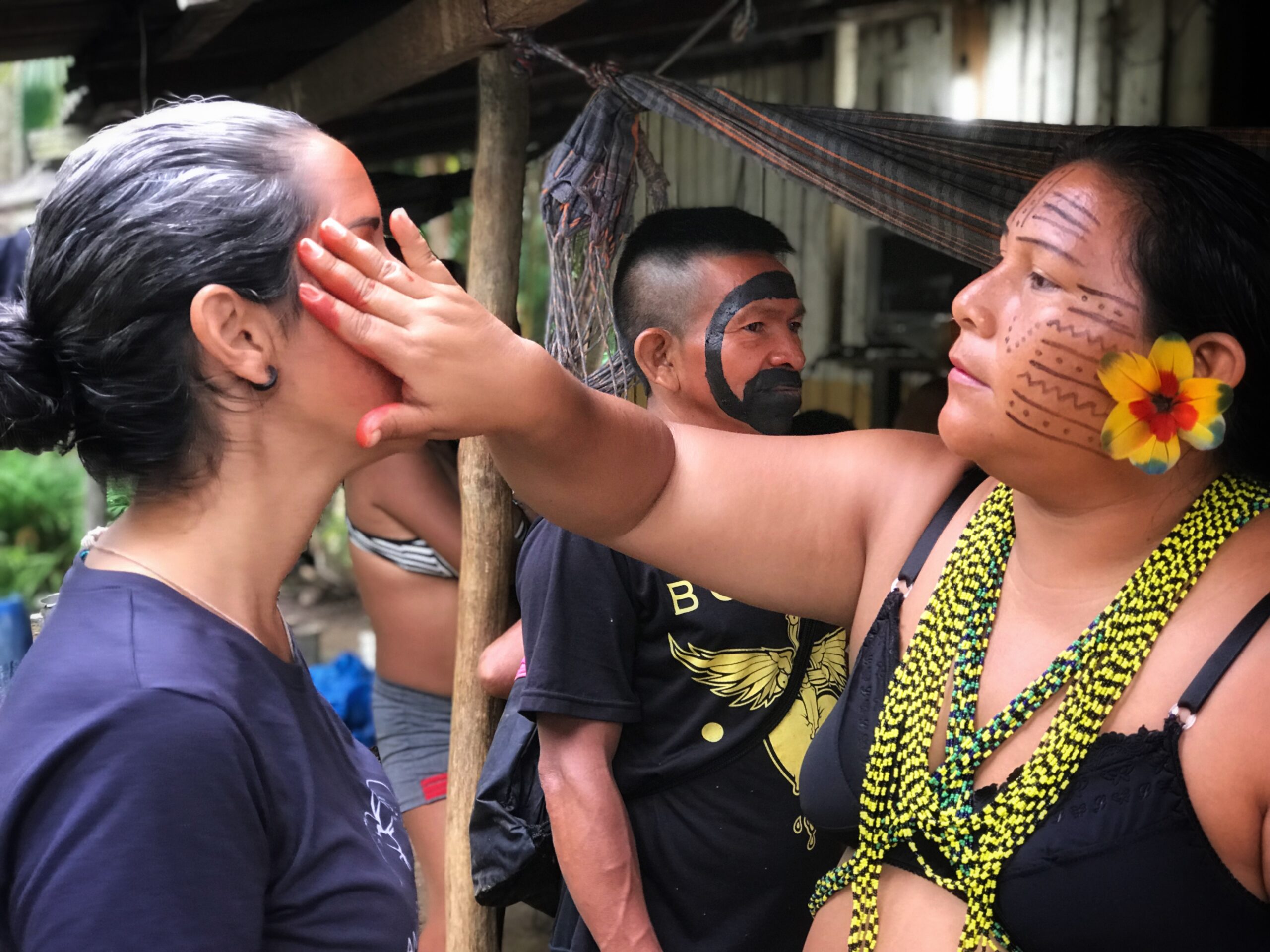
We are visitors in their territory.
That changes the relationship.
The mountain doesn’t become ours because we paid to climb it.
Tourism as a Tool for Territorial Protection
This is perhaps one of the most important dimensions of the Yaripo project.
Community-based tourism can generate income, but its potential goes beyond economics.
Funai explicitly connects the Yaripo initiative with territorial protection, noting that economic alternatives can help reduce pressures associated with illegal mining while a stronger Yanomami presence along the route contributes to territorial surveillance.
This is an important reminder of what responsible tourism can become.
Travel doesn’t have to exist separately from conservation and local priorities.
Under the right governance, it can contribute to them.
For me, this is one of the reasons Yaripo represents something much larger than an adventure tourism product.
Respecting Yanomami Territory
Travelers entering Yaripo are entering Indigenous territory, and there are clear rules of conduct.
Current visitation requirements include respecting Yanomami customs, beliefs and traditions; following the instructions of guides; remaining on authorized routes; carrying out all waste; avoiding extraction of plants, animals or other natural materials; and following specific rules concerning photography and filming.
These should not be understood as inconveniences.
They are part of being a respectful visitor.
There will be places you cannot go.
Things you should not photograph without permission.
Rules you need to follow even if they are different from what you are accustomed to elsewhere.
Access to a place does not mean entitlement to everything within it.
What Will You See Along the Way?
Anyone who approaches Yaripo only as a mountaineering challenge may be surprised by how much of the experience happens before reaching the high elevations.
The journey begins within tropical rainforest.
Rivers, enormous trees, palms, fungi, insects, birds and countless details accompany the trail.
As altitude increases, the vegetation gradually changes.
The landscape becomes increasingly unusual.
Clouds and mist can move rapidly across the mountain.
Plants adapted to higher elevations begin replacing the lowland rainforest vegetation.
And eventually there is the strange sensation of looking across an immense region of Amazonian forest from above.
It is one of those moments when you understand the scale of the Amazon in a way maps rarely communicate.
What About Wildlife?
Wildlife is present throughout the region, but Yaripo should not be approached as a wildlife safari.
Dense rainforest makes many animals difficult to observe.
You may hear wildlife you never see.
You may find tracks or signs.
Birds, insects, amphibians, reptiles and smaller creatures can be particularly fascinating along the trail.
But there are no guaranteed wildlife encounters.
The expedition is about experiencing an ecosystem rather than collecting sightings.
Who Is the Pico da Neblina Trek For?
I would recommend Yaripo to travelers who:
Already enjoy trekking.
Who are physically prepared.
Who can accept basic conditions.
Who understand that rain and mud are part of the journey.
Who are comfortable with uncertainty.
Who are genuinely interested in Indigenous culture rather than simply looking for an exotic backdrop.
Who understand that reaching the summit is an objective, not a guarantee.
And perhaps most importantly:
people who enjoy the journey as much as the destination.
If your primary concern is comfort, there are extraordinary ways to experience the Amazon without undertaking an expedition of this intensity.
Yaripo is something different.
What Makes Pico da Neblina Different From Other Famous Treks?
I have trekked in different environments over the years, and one of the things that makes Yaripo extraordinary is how difficult it is to separate the mountain from everything surrounding it.
This isn’t simply:
trail → mountain → summit.
It is:
river → community → rainforest → culture → expedition → mountain.
You cannot remove Yaripo from Yanomami territory and still have the same experience.
You cannot remove the rainforest.
You cannot remove the journey required to reach it.
And I don’t think you should try.
That complexity is exactly what makes this expedition extraordinary.
More Than Reaching Brazil’s Highest Point
When I think about my own experiences trekking in the Amazon, the memories that stay with me are rarely just the destinations.
I remember the people.
The exhaustion.
The laughter.
The rain.
The meals after long days.
The feeling of waking in the forest.
The moments when I wondered why I had voluntarily chosen to put my body through something so difficult.
And then the moments when the answer became completely obvious.
Yaripo gives you many of those moments.
Of course, standing at the highest point in Brazil can be extraordinary.
But eventually you descend.
And what you bring back is something much harder to measure.
For me, the greatest value of an expedition is not reaching somewhere few people have reached.
It is discovering what happens to us along the way.

Frequently Asked Questions
How high is Pico da Neblina?
Pico da Neblina reaches approximately 2,995 meters above sea level, making it the highest mountain in Brazil.
Is Pico da Neblina called Yaripo?
Yes. Yaripo is the Yanomami name associated with the mountain known in Portuguese as Pico da Neblina. It is a sacred place within Yanomami territory.
How difficult is the Pico da Neblina trek?
It is a demanding multi-day rainforest expedition involving long walking days, humidity, mud, rain, steep terrain, altitude and basic camping conditions. Previous trekking experience and good physical preparation are strongly recommended.
How long is the Pico da Neblina trek?
The current Yaripo visitation information describes eight days of walking through the Amazon rainforest to reach the summit, while the complete journey requires additional time for access, logistics and return.
Can anyone visit Pico da Neblina independently?
No. Visitation is regulated and must follow the authorized Yaripo visitation framework. In 2026, ICMBio again conducted a formal accreditation process for tourism operators serving the Pico da Neblina visitation program.
Is the summit guaranteed?
No. Weather, trail conditions, safety and the physical condition of participants can affect the expedition. Responsible trekking should always prioritize safety over reaching the summit.
Can visitors photograph Yanomami people?
Photography and filming must respect Indigenous authorization and current visitation rules. The 2026 Funai information specifically states that photographs, recordings and filming require authorization from the Indigenous people concerned.
Is Pico da Neblina suitable for first-time trekkers?
I would not recommend Yaripo as a first multi-day trek. Previous trekking experience makes it much easier to understand your own physical limits and adapt to consecutive days of demanding hiking.
Written by Vanessa Marino
Founder of Amazon Emotions · Naturalist · Conservation Advocate · Expedition Leader
Vanessa’s relationship with Amazonian expeditions began in 1998. Since then, trekking has taken her through some of the most remote landscapes of the Brazilian Amazon and has shaped the way Amazon Emotions approaches adventure, conservation and meaningful travel.


